


Conservation Needs Assessment Summary

Itatiaia Highland Frog
(Holoaden bradei)
Brazil, Assessed 14 Nov 2020
Assessment details
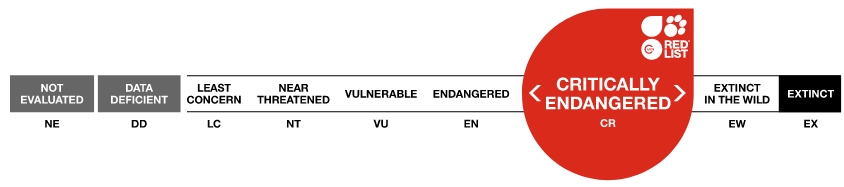
There is a strong possibility that this species might be extinct in the wild. The last specimen was collected in 1979. In 1985, some individuals was recorded, but from 1991 no others have been found. During 2004-2006, extensive field surveys in its original distribution area was carried out to find this species. In addition, educational and scientific excursions to the area are frequently undertaken, but without success in finding the species (S.P. Carvalho-e-Silva, pers. comm. 2020).
It is likley that less than 50% of the individuals of this species are included within one or more well-managed or reliably protected areas. The entire population of this species originally occurred in the Parque Nacional do Itatiaia.
Enough well-managed and reliably protected habitat exists, either within or outside of currently protected areas that is suitable for conservation translocation, including population restoration or conservation introduction. Parque Nacional do Itatiaia This species occurs on the ground, under mulch and leaves, which is also where the eggs are laid. It hides under stones and in terrestrial bromeliads in open grassland, and probably breeds by direct development.
It is unlikely that any in situ conservation actions are in place for this species.
Additional in situ research is required to better understand the species. Extensive field surveys (active search and pitfall traps) have been carried out to find this species. Additional technologies, such as environmental DNA and/or automated acoustic recorder, are recommended to implement the search for individuals. It’s also necessary to understand the causes for the species' disappearance.
Either no knowledge about the threats to this species exists, or there is so little information known about the distribution of the species in the wild, that the threats cannot be determined. The causes for the species' disappearance are unknown.
It is likely that the known population of this species in the wild is too small to recover naturally, without ex situ intervention, even if threats are mitigated.
A Species Action Plan does not exist for this species. There is no specific plan for this species, but it is part of the National Action Plan "Plano de Ação Nacional para a Conservação da Herpetofauna Ameaçada da Mata Atlântica da Região Sudeste do Brasil" (PAN Herpetofauna do Sudeste)
If an ex situ rescue program is recommended for this species, an analog species would be required to develop husbandry protocols first. Holoaden luederwaldti
This species has not been held in captivity to date.
It is unlikely that sufficient animals would be available or potentially available to initiate an ex situ program, if one was recommended.
https://conservationneeds.org/assessment/967
Citation: A.M.P. T. Carvalho-e-Silva, L.F. Toledo and S.P. Carvalho-e-Silva 2020. Conservation Needs Assessment for Holoaden bradei, Brazil (AArk/ASG Brazil Assessment Workshop).
https://conservationneeds.org/summaryreport/967 Accessed 30 Apr 2026
